

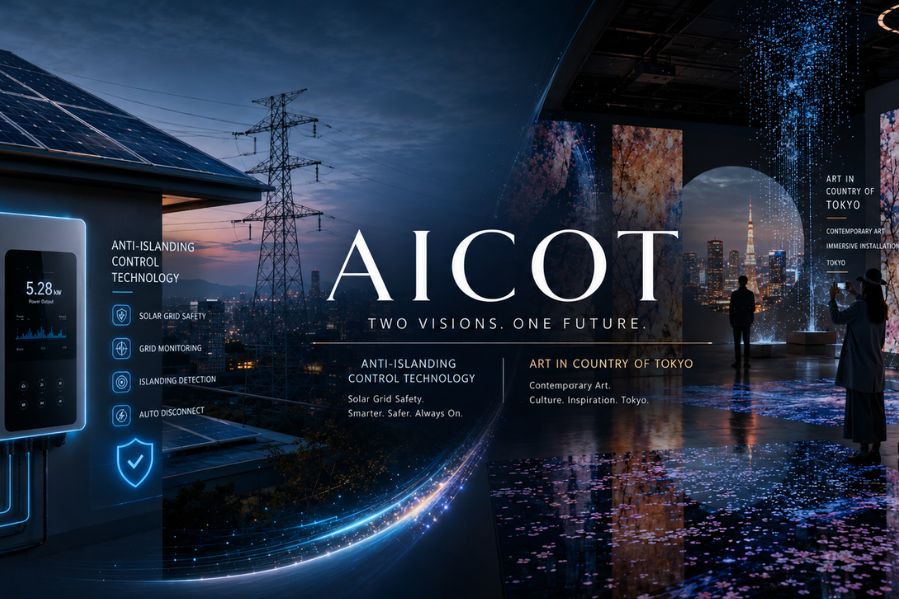
AICOT is a unique term because it represents two completely different ideas, each connected with innovation, technology, and the future. In the renewable-energy sector, AICOT refers to Anti-Islanding Control Technology, a safety system designed to help solar power installations disconnect from the electricity grid during outages and prevent dangerous electrical islanding. This technology plays an important role in making modern solar networks safer, more reliable, and easier to manage, especially in locations where several photovoltaic systems operate close to one another. In a completely separate cultural context, AICOT also stands for Art in Country of Tokyo, an international contemporary-art initiative that explores environmental, social, and technological subjects through immersive exhibitions, experimental films, digital installations, virtual reality, and augmented reality. Although these two meanings are unrelated, both reflect a desire to use creativity and advanced thinking to respond to modern challenges. One focuses on safer and cleaner energy systems, while the other uses art to encourage people to think deeply about nature, technology, cities, and the future of society. Understanding both meanings makes it easier to recognise why the term AICOT appears in such different industries.
What Is AICOT?
The term AICOT can be confusing because it does not refer to a single entity; instead, it is used in two separate and established contexts. In the renewable-energy industry, AICOT stands for Anti-Islanding Control Technology, a solar-safety technology developed by the Japanese electronics company Omron. In the cultural sector, AICOT represents Art in Country of Tokyo, an international contemporary-art project that uses exhibitions, performances and digital media to examine environmental and humanitarian subjects. These meanings are not connected commercially or technically, but both demonstrate how innovation can address important modern challenges.
Understanding the context in which the term appears is therefore essential. A discussion involving solar panels, electrical grids, power conditioners or photovoltaic systems is almost certainly referring to Omron’s anti-islanding technology. A reference involving Tokyo, artists, exhibitions, experimental film, virtual reality or environmental installations is more likely to describe the Art in Country of Tokyo initiative. Recognizing this distinction prevents readers from incorrectly treating AICOT as a single organization or digital product.
AICOT as Anti-Islanding Control Technology
In the energy industry, AICOT means Anti-Islanding Control Technology. It was developed to improve the safety and reliability of solar power systems, particularly in locations where several photovoltaic systems are connected within the same neighborhood or electrical network. Solar installations have become increasingly common on houses, apartment buildings, commercial properties and community developments. However, connecting numerous solar systems to the same grid can create technical complications that must be controlled carefully.
A solar power system normally operates alongside the electricity supplied by a utility company. The solar panels generate direct-current electricity, while an inverter or power conditioner converts that electricity into a form suitable for household appliances and the wider grid. When the public power supply is operating normally, the solar system and the grid can work together. During an outage, however, the solar installation must recognize the loss of grid power and stop sending electricity into the affected network unless it has been specifically designed to operate safely as an isolated backup system.
Understanding the Danger of Islanding
Islanding occurs when a local power source continues supplying electricity to part of a network after the main utility grid has shut down. This condition can be dangerous because workers repairing damaged equipment may believe that the power lines are inactive. If a solar installation continues energizing those lines, technicians could face a serious electrical hazard. Islanding can also create unstable voltage or frequency levels, potentially damaging electrical equipment and making the restoration of normal grid service more difficult.
Traditional anti-islanding mechanisms were designed to detect changes in the electrical network and disconnect the solar system when necessary. The challenge became more complicated as larger numbers of inverters were installed close together. Their detection signals could interfere with one another, making it necessary to conduct additional tests before approving multiple installations. These testing requirements could increase costs, delay projects, and restrict the amount of solar-generating capacity permitted in a particular area.
How Omron’s AICOT Improves Solar Safety
Omron developed AICOT to prevent dangerous islanding while reducing problems caused by interference between several power conditioners. The technology monitors electrical conditions and helps the inverter respond rapidly when abnormal grid behavior is detected. Omron has stated that its system can identify islanding through frequency changes and stop the condition in approximately 0.2 seconds. This rapid response is important because the purpose of the technology is not merely to recognize an outage but to prevent locally generated electricity from continuing to energize an unsafe section of the grid.
One of the major advantages of AICOT is its ability to work in environments where numerous solar systems are connected nearby. Earlier approaches often required physical interference testing to confirm that multiple anti-islanding systems would not disrupt one another. AICOT was developed to reduce or eliminate the need for these extensive tests in compatible installations. This helped simplify the approval process and allowed more solar systems to be installed across residential communities.
Why AICOT Matters for Solar Communities
The importance of AICOT becomes clearer when considering the growth of distributed energy generation. Electricity was once produced mainly by large power stations and delivered in one direction to homes and businesses. Solar technology has changed that model. Individual properties can now generate electricity, use part of it locally and sometimes send surplus energy back into the grid. This creates a more decentralized energy system containing thousands of small power sources rather than a limited number of large generating facilities.
A decentralized network can support cleaner energy and reduce dependence on fossil-fuel generation, but it also requires reliable coordination. Every connected inverter must respond correctly during an electrical disturbance. AICOT helps address this requirement by making anti-islanding protection more dependable in areas with many connected systems. Its purpose is particularly relevant to solar towns, apartment developments, and densely populated neighborhoods where rooftop installations may operate within a relatively small area.
The technology can also support the economic expansion of solar power. When developers are required to conduct complicated interference tests or Install additional protective equipment, project costs rise. By simplifying technical assessments and reducing certain infrastructure requirements, AICOT can make larger community installations more practical. This does not remove the need for professional engineering, regulatory approval, or compliance with local electrical standards, but it can make the integration process more efficient.
AICOT and the Future of Renewable Energy
The value of anti-islanding protection is likely to remain significant as renewable-energy systems become more advanced. Modern homes may combine rooftop solar panels, battery storage, electric vehicles and smart energy-management equipment. These technologies allow households to control when electricity is generated, stored or consumed. However, increased flexibility also creates a more complex relationship between individual properties and the public grid.
Technologies such as AICOT demonstrate that renewable-energy progress depends on more than producing efficient solar panels. Safe power electronics, intelligent inverters and dependable control systems are equally important. A solar system must generate clean electricity while also responding correctly to outages, voltage changes and other network conditions. Anti-islanding technology is therefore an essential part of the wider infrastructure supporting the transition towards decentralized and lower-carbon energy.
AICOT as Art in Country of Tokyo
The second recognized meaning of AICOT is Art in Country of Tokyo, an international contemporary-art initiative. Unlike the technical solar application, this AICOT belongs to the cultural and creative world. The project presents Tokyo not only as a densely populated global city but also as a wider region containing islands, coastlines, mountains, fields and local communities. Its exhibitions encourage audiences to reconsider the relationship between urban identity, regional landscapes and the natural environment.
The word “country” within the project’s name carries more than one meaning. It can describe a nation, but it can also refer to a region or countryside. Art in Country of Tokyo uses this broader interpretation to challenge the common image of Tokyo as nothing more than skyscrapers, busy railway stations and crowded commercial districts. By organizing events outside conventional metropolitan art spaces, the initiative highlights the geographical and cultural diversity found throughout Tokyo.
Experimental Art Beyond Traditional Galleries
Art in Country of Tokyo does not limit itself to standard paintings displayed inside formal galleries. Its programs have included experimental films, video installations, performances, sound art, augmented reality, virtual reality, and underwater artworks. These formats allow artists to explore subjects that may be difficult to communicate through conventional exhibitions. Digital and immersive media can place viewers inside imagined environments, while site-specific installations can connect artistic ideas directly to a physical location.
The use of unusual exhibition spaces is an important feature of the initiative. Public buildings, underground venues, regional facilities and island environments can become part of the artistic experience. Instead of treating the venue as a neutral background, participating artists may respond to its history, natural surroundings or relationship with the local community. This approach encourages visitors to examine not only the artwork but also the place in which it appears.
Environmental and Humanitarian Themes
A major theme associated with the art-focused AICOT is the relationship between humanity, technology and the environment. Its projects have asked audiences to imagine the present from the perspective of people living in the distant future. Underwater artworks, for example, can be viewed as if they were archaeological remains from a previous civilization. Similarly, technologies such as VR and AR may be presented as ancient tools being examined by future societies.
This perspective encourages viewers to question what evidence the modern world will leave behind. Plastic pollution, damaged ecosystems, abandoned technology and climate-related changes could all become part of the historical record inherited by future generations. Rather than presenting environmental concerns only through scientific statistics, contemporary art can make these issues personal, emotional and imaginative.
International participation further expands the project’s outlook. Artists and cultural organizations from different countries bring distinct experiences of urbanization, environmental change and technological development. Their work can demonstrate that ecological problems are not restricted to one region. Rising seas, changing climates, disappearing habitats and the social effects of rapid technological growth are global concerns requiring cooperation across national and cultural boundaries.
The Role of Technology in AICOT’s Art
Technology is not treated simply as a display tool within AICOT exhibitions. It can become part of the message itself. Virtual reality can recreate environments that no longer exist, while augmented reality can place digital objects within real landscapes. Video and sound installations can combine documentary evidence with fictional storytelling, allowing audiences to experience several perspectives at once.
This creative use of technology also raises questions about memory and preservation. Digital artworks may appear modern and permanent, yet software, storage formats and electronic devices can quickly become obsolete. By imagining today’s advanced technology as an archaeological object, AICOT encourages viewers to reconsider the belief that digital progress is endless or indestructible.
What the Two Meanings Have in Common
Omron’s Anti-Islanding Control Technology and Art in Country of Tokyo are entirely separate uses of the same acronym. One belongs to electrical engineering, while the other belongs to contemporary culture. Nevertheless, they share a broad interest in the relationship between human activity, technology and the environment.
The solar meaning of AICOT supports the safer expansion of renewable electricity. The artistic meaning encourages people to think critically about environmental responsibility, technological development and the legacy left to future generations. One provides a practical engineering response, while the other creates space for cultural reflection. In different ways, both meanings are connected to the challenge of building a more sustainable future.
How to Identify the Correct AICOT Meaning
The surrounding language usually reveals which definition is intended. References to solar inverters, photovoltaic power, grid outages, islanding, frequency detection, or power conditioners indicate Omron’s Anti-Islanding Control Technology. References to exhibitions, Tokyo, Shikinejima, artists, performances, environmental installations, VR or experimental film indicate Art in Country of Tokyo.
It is also important not to assume that AICOT is automatically related to artificial intelligence simply because its first two letters are “AI.” Although digital technology may appear in the art initiative, and advanced control processes are used in the solar system, AICOT is not generally the name of a mainstream AI chatbot or a single artificial-intelligence service.
Conclusion
AICOT is a context-dependent term with two important but unrelated identities. In renewable energy, it represents Omron’s Anti-Islanding Control Technology, which helps solar inverters disconnect safely during grid failures and supports the installation of multiple photovoltaic systems within the same area. Its development reflects the growing need for intelligent safety controls as electricity generation becomes more decentralized.
In the arts, AICOT stands for Art in Country of Tokyo. This international initiative uses contemporary exhibitions, performances and immersive technologies to examine regional identity, environmental change and humanity’s future. By taking art beyond conventional galleries, it encourages audiences to see Tokyo as both a global capital and a diverse natural region.
Whether it appears in a technical document or an arts program, AICOT represents an effort to respond thoughtfully to modern change. One meaning protects evolving energy systems, while the other challenges people to consider how generations will remember technology, society, and nature still to come.
